
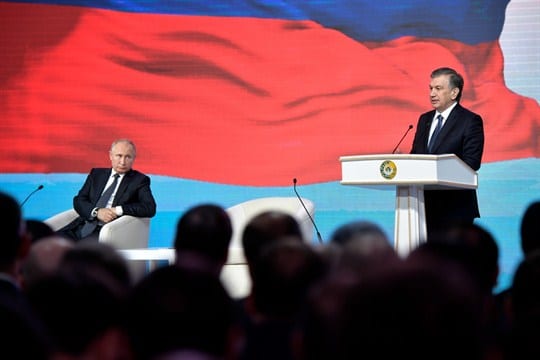
Russian President Vladimir Putin and President of Uzbekistan Shavkat Mirziyoyev, right, during the Uzbekistan-Russia Interregional Cooperation Forum, Toshkent, Uzbekistan, Oct. 19, 2018 (Photo by Aleksey Nikolskyi for Sputnik via AP Images)
On October 25, World Politics Review (WPR), featured the article As Uzbekistan Opens Up, the Goal Is Economic Modernization, not Liberalization by Edward Lemon, Ph.D. in keeping with their goal to “provide uncompromising analysis of critical global trends to give policymakers, analysts, academics, and readers with a deep interest in international affairs the context they need to have the confidence they want.” Lemon writes:
“Within the region, Uzbekistan has moved to mend ties with its neighbors, trying to position itself as the hub of Central Asia both politically and economically. Beyond the region, Uzbekistan is pursuing ambitious policies aimed at globalizing the Uzbek economy, courting Russia, China, the United States, Turkey and Iran. These moves have produced results. Many observers have concluded that an “Uzbek spring” has brought a thaw to what was one of the world’s most repressive states. Change certainly is in the air, so much so that it is impossible to keep track of all the many, albeit piecemeal reforms. But what is motivating all this change, and what are its limitations?”
Edward Lemon is the DMGS-Kennan Institute Fellow at the Daniel Morgan Graduate School, where he utilizes his significant knowledge of authoritarian governance, religion, security, and migration in Eurasia to prepare DMGS students to “develop actionable solutions to global security challenges.” DMGS provides unique academic training that helps students to understand international security challenges from regions across the globe.
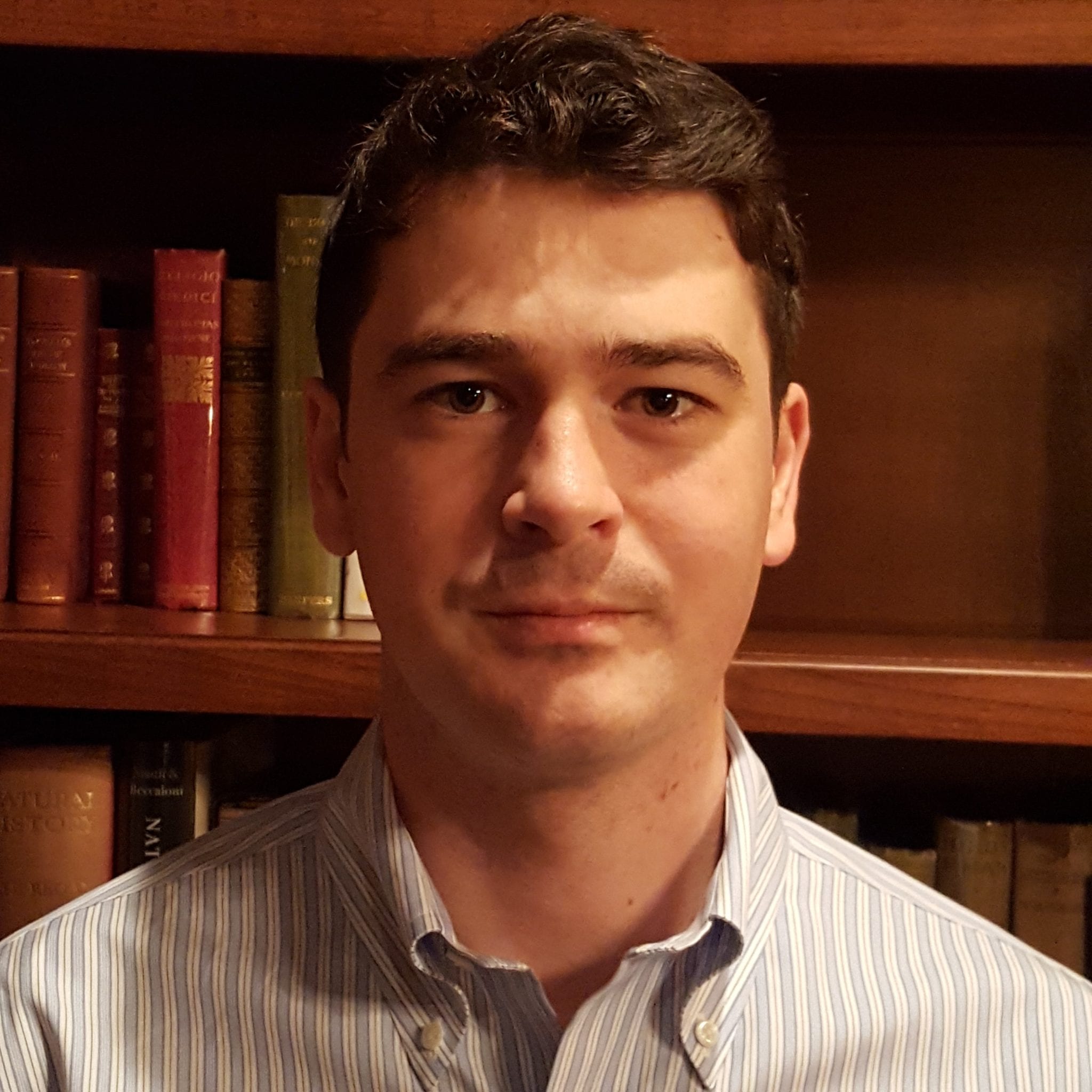
Edward Lemon, Ph.D. is the DMGS-Kennan Institute Fellow at the Daniel Morgan Graduate School.
Between September 2016 and August 2018, Dr. Lemon was a Mellon Postdoctoral Teaching Fellow at the Harriman Institute at Columbia University. He gained his PhD in international studies from the University of Exeter in the United Kingdom in 2016.
